

ERTC Texas: Complete Guide to Eligibility, IRS Deadlines, and Filing Tips

ERTC Texas provides a refundable tax credit to businesses and tax-exempt groups that kept staff on their payroll during the COVID-19 pandemic. To qualify for this help, your business must have paid wages to employees between March 13, 2020, and December 31, 2021. According to the IRS, this credit helps employers who faced government shutdowns or saw a big drop in their sales. This is not a loan or a tax deduction. It is a cash payment that puts money back into your Texas business. Many small firms using tax services in Dallas for businesses can still file for this credit to help their cash flow. Learning the rules is key to getting help while staying safe with tax laws.
Contact Seamless for a free ERTC eligibility review for your Texas business. Our team helps you determine whether you qualify and how much you can claim.
Many local owners have questions about how these tax rules apply to their case in Texas. Let us start with the basics of how this credit works for your firm.
ERTC Texas: What Is the Employee Retention Tax Credit (ERTC)?
The Employee Retention Credit (ERC or ERTC) is a refundable federal tax credit for businesses and tax-exempt organizations that kept employees on payroll during the COVID-19 pandemic. It was created by the CARES Act in March 2020 and expanded by subsequent legislation. Unlike a tax deduction, this credit directly reduces the taxes you owe and can result in a cash refund if the credit exceeds your tax liability.
The Employee Retention Credit (ERC or ERTC) is a federal relief fund. It helps firms and groups that kept staff on the job during the recent health crisis. The IRS built this credit to reward those who did not lay off their teams. It is a refundable tax credit for shops that had workers and were hit by the pandemic. For many in Texas, this money has been a key way to grow after tough times.
A tax credit versus a deduction
Many business owners do not know how a credit differs from a tax break. A normal tax break, or deduction, lowers the profit you pay tax on. A credit is much better because it cuts your tax bill directly. Since the ERTC is refundable, it can lead to a check from the IRS. This happens if the credit is worth more than the taxes you owe. It acts as a cash grant for the wages you paid to your team.
This fund was part of the CARES Act and other laws. It was meant to help shops stay afloat when the world shut down. If your firm had to close or saw a big drop in sales, you may get these funds. Working with experienced small business CPA services can help ensure your claim is accurate and complete.
Eligibility dates for the credit
To get the credit, your firm must have paid wages at the right time. The period for ERTC Texas claims starts on March 13, 2020 and runs through December 31, 2021. This timeline covers most of the major pandemic waves. During these years, many Texas towns saw local rules that changed how they did work.
You can still claim the credit now by filing a change to your old tax forms. But you must act fast because some deadlines are near. The credit covers wages and health care costs paid during those dates. You must have been in business and had workers on your payroll to qualify.
Limits on who can claim
Not every type of worker or firm can get this credit. For example, the ERTC is not for people who work alone. If you do not have staff on a W-2 payroll, you cannot claim it. This means sole owners with no team are not eligible. The credit is built for firms that had to keep staff on the books during the slump.
Also, some types of pay do not count for the credit. You cannot use wages that were already paid for with a PPP loan. The IRS is very strict about this rule. They want to make sure no one gets paid twice for the same cost. Working with a pro firm like Seamless can help you tell the difference. We make sure your claim is clear and follows all the rules. Explore our integrated financial and tax planning approach to better understand how ERTC fits into your broader strategy.
Which Texas Businesses Qualify for the ERTC?
Texas businesses qualify for the ERTC if they meet one of three conditions during the covered period: a full or partial suspension of operations due to a government order. A significant decline in gross receipts (50% or more for 2020, 20% or more for 2021). Or status as a recovery startup business (began operations after February 15, 2020, with average annual gross receipts under $1 million).
To get the Employee Retention Credit (ERC or ERTC), your Texas business must meet certain rules. The IRS set these rules to help shops and firms that kept staff on the payroll during the pandemic. Most private firms and groups that do not pay taxes can apply if they fit the right marks. These rules changed based on when you paid your workers. You must look at the specific dates to see if you can claim the money.
Paths to get the credit
You can qualify for the ERTC Texas in three main ways. First, your firm might have seen a full or partial stop in work due to a government order. Second, you could have had a big drop in your gross receipts. Third, your firm might be a recovery startup business. The IRS eligibility checklist shows how these rules changed over time. The time period you claim for will change what you need to prove.
It is vital to look at each part of 2020 and 2021 to find where you fit. Some firms qualify for one year but not the other. This is because the bar for entry shifted as the pandemic went on. You should check your status for every three month block of time.
The gross receipts test
A big drop in sales is a common way to qualify. For the year 2020, your gross receipts must have dropped by 50% or more. You compare each quarter in 2020 to the same quarter in 2019. This rule became much easier for firms in 2021. For 2021, you only needed a 20% drop compared to 2019. This means more Texas firms can get help for the second year of the program.
Many firms in the Dallas-Fort Worth area find this test very helpful. If you are unsure about your numbers, you should look for tax services in Dallas for Texas businesses. A pro can help you check your books and find your drop in sales. They can also tell you which wages you can count for the credit.
Government shutdown orders
Your firm may also qualify if a government order forced you to close or slow down. This includes local or state orders that limited your hours or your space. For example, a restaurant that could only offer take-out might fit this rule. Even a partial stop in work can make you eligible for the credit. The order must have come from a government body and not just a suggestion.
This rule applies for the time the order was in place. You must show how the order directly hurt your way of doing business. This is why keeping good records is a key part of the process. You will need to show the exact dates your work was limited by the law.
Recovery startup businesses
New firms can qualify if they started after Feb. 15, 2020, with average gross receipts under $1 million. This path helps firms that opened during the pandemic even without a sales drop or shutdown. It applies only to Q3 and Q4 of 2021 with a max of $50,000 per quarter.
Who does not qualify?
Not every group can get the ERTC. Household employers do not qualify for the credit. This means you cannot claim it for staff who work in your private home. This is a common point of confusion for many taxpayers.
Also, a supply chain issue alone is not enough to qualify. You must meet one of the three main paths listed above. The credit is only for firms that pay wages to employees. Check your group type before you try to file.
How Much Can a Texas Business Claim Through the ERTC?
The maximum ERTC claim per employee depends on the year. In 2020, the credit was 50% of up to $10,000 in qualified wages per employee for the year, yielding a maximum of $5,000 per employee. In 2021, the credit increased to 70% of up to $10,000 in qualified wages per employee per quarter. Yielding up to $7,000 per quarter or $21,000 per employee for the last three quarters of 2021.
Finding the exact value of your Employee Retention Tax Credit (ERTC) depends on when you paid your team. The rules changed a lot between 2020 and 2021. For most Texas firms, the credit is worth much more than a simple tax deduction because it is a refundable credit.
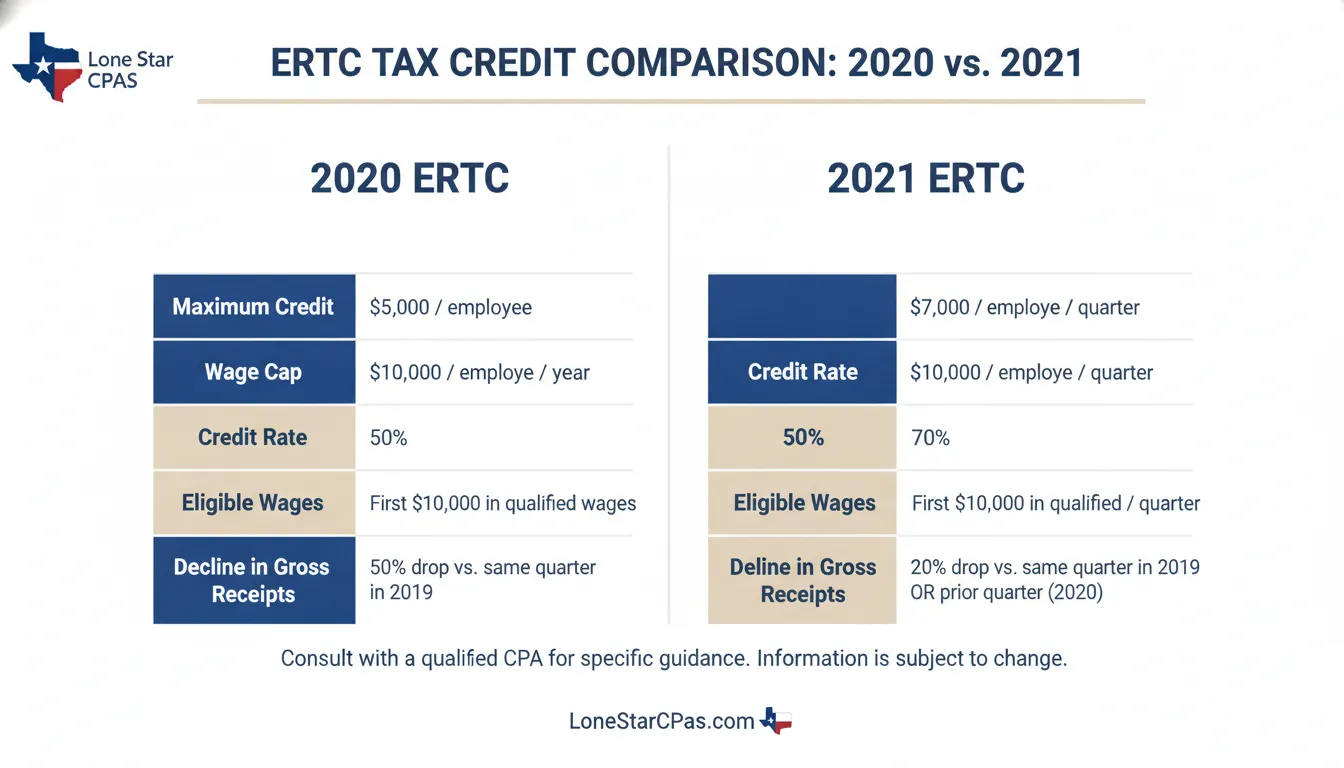
Key differences between 2020 and 2021 credits
The IRS set different limits for wages and credit rates based on the tax year. In 2020, the credit applied to wages paid from March 13 through the end of the year. By 2021, the credit grew to cover more wages at a higher percentage. You can check the official IRS rules to see which periods apply to your trade or business.
| Parameter | 2020 | 2021 |
|---|---|---|
| Credit Rate | 50% of wages | 70% of wages |
| Max Qualified Wages | $10,000 per year | $10,000 per quarter |
| Max Credit per Employee | $5,000 per year | $7,000 per quarter ($21,000 total) |
| Gross Receipts Decline | 50% or more | 20% or more |
| Employer Size Limit | 100 full-time staff | 500 full-time staff |
How to find your qualified wages
Qualified wages are the base for your claim. These include the gross pay you gave to each person on your payroll. You can also include the cost of group health plan expenses that you paid for them. For a Dallas firm with a large team, these health costs can add a large amount to the final claim. You should track these costs for each quarter to get an exact total.
The IRS uses different rules for small and large employers. If you had fewer than 100 full-time staff in 2019, you can claim the credit for all wages paid in 2020. In 2021, this limit went up to 500 staff. This change allowed many more mid-sized Texas firms to get help during the pandemic. If you were over the limit, you can only claim wages for staff who were not working due to a shutdown.
Tax planning for Texas business owners
Claiming this credit is a key part of your broad business tax planning strategies. You must make sure you do not "double dip" if you also took a PPP loan. You cannot use the same wages for both programs. A clear look at your books helps you pick which wages go to which benefit to get the best result. This careful check protects your firm from risks during an IRS review.
Many local owners feel lost when they try to match these numbers. The math gets hard when you look at how the 20% receipts drop applies to each quarter. For example, a DFW firm might compare Q1 of 2021 to Q1 of 2019 to see if they fit the rule. Getting the math right the first time helps you avoid delays or audits from the IRS later on. A solid plan ensures your firm stays strong and ready for future growth in the Texas market.
Can You Claim the ERTC if Your Texas Business Received a PPP Loan?
Yes, Texas businesses can claim both the ERTC and PPP loan forgiveness, but they cannot use the same wages for both programs. The Consolidated Appropriations Act (CAA) of 2021 removed the original prohibition on dual participation. Businesses must carefully allocate wages between PPP forgiveness and ERTC qualification to maximize both benefits without triggering an IRS audit.
The short answer is yes. Many owners in the Dallas-Fort Worth area think they must choose between the Paycheck Protection Program (PPP) and the Employee Retention Credit (ERTC). At first, the law made you pick one. But a change in federal law let businesses use both programs at the same time. This is great news for any Texas business that kept staff on the payroll during the pandemic.
The No Double Dipping Rule
While you can use both programs, you cannot "double dip" on the same dollar. You cannot claim the ERTC using wages that you already paid with a forgiven PPP loan. The IRS is very strict about this. They want to make sure the same payroll cost does not get two different tax perks. If you use the same wages for both, you might face an audit or have to pay the money back with interest.
Most local firms must look at their payroll records quarter by quarter. You have to map out which wages went toward your PPP loan and which ones stay open for the ERTC. Good business tax planning strategies help you see these gaps. By splitting your costs the right way, you can get the full benefit of both programs without breaking any rules.
How to Group Your Costs
The best way to get the most from your claim is to look at your other costs first. When you apply for PPP loan forgiveness, you can use up to 40% of the loan for things like rent and bills. If you use those costs for PPP, you save more of your payroll for the ERTC. This split lets you claim a higher tax credit while still getting your loan forgiven.
This process takes a lot of math. You have to account for every dollar you paid to your team. You also need to watch out for caps on how much you can claim for each person. Since the rules for 2020 and 2021 are not the same, the math can get hard. Most owners find that having a CPA check their work is the safest move. Our small business CPA services are designed to handle this type of complex calculation.
The Need for Good Records
If the IRS asks about your claim, you will need to show your work. You should keep clear records of your payroll, your PPP loan papers, and how you split the costs. Texas business owners should save these files for at least seven years. Clear records prove that you followed the law. It is much easier to keep good files now than to hunt for them during an audit later.
Working with a tax pro ensures your math is right. At Seamless, we help Texas businesses find these hidden savings. Our team handles the hard math so you can stay focused on your business growth. Learn how we integrate back office accounting services with your tax strategy for a complete picture.
What Is the Current Status of ERTC Claims at the IRS?
The IRS is currently conducting deep reviews of all ERTC claims due to widespread fraud concerns. A moratorium on processing new claims was in place while the agency scrutinized filings. Under the One Big Beautiful Bill (OBBB), signed July 4, 2025, claims for Q3 and Q4 of 2021 filed after January 31, 2024, may be denied. The IRS also has expanded audit authority and offers a withdrawal program for businesses that filed in error.
The IRS is closely reviewing Employee Retention Tax Credit (ERTC) claims due to a high number of improper filings. Many businesses face long delays as the agency works to spot fraud and error. For Texas business owners, this means your claim might take much longer than expected to process. The IRS has put a moratorium on new claims while they focus on these deep reviews. This step helps the agency guard against promoters who sold bad tax advice to small firms.
IRS Review of Improper Claims
The IRS continues to express concern about a large number of improper ERC returns. They are performing close reviews of all filings to ensure each business truly qualifies. Many promoters lured companies into filing for the credit even if they did not meet the rules. Because of this, the IRS now checks each claim with more care. This scrutiny is part of a larger push to stop tax abuse and protect honest taxpayers from future audits.
If you filed a claim that you now think is wrong, the IRS offers a way out. The ERC withdrawal program lets you take back a claim if it has not been paid yet. This can help you avoid audits, large fines, and interest. For many firms in the Dallas area, talking to a pro is the best way to check if their filing is safe. You should look into integrated financial and tax planning to make sure your business stays on track and meets all laws.
Impact of the One Big Beautiful Bill (OBBB)
The One Big Beautiful Bill (OBBB), signed on July 4, 2025, brought new rules for ERTC claims. One key change affects claims for the third and fourth quarters of 2021. If you filed these claims after January 31, 2024, the IRS may not allow or refund them after July 4, 2025. This limitation on refunds is part of a plan to cap the program's costs and stop late, high-risk filings. This bill gives the IRS more tools to fight tax credit abuse and penalize promoters who break the rules.
Texas businesses must stay up to date on these fast-moving tax changes. The OBBB also gives the IRS more time to audit old claims to find errors. This means that getting your refund is not the final step in the process. You must keep all your tax records and be ready to prove your claim if the IRS asks. Working with a local CPA firm helps you handle these complex rules and keep your business ready for any future audit. If you are dealing with tax debt concerns, our tax relief services for business owners can help you navigate IRS requirements.
How To File and Claim the ERTC for Your Texas Business
To file an ERTC claim, Texas businesses must amend their quarterly payroll tax returns using IRS Form 941-X. The process involves gathering payroll records from 2020 and 2021, calculating qualified wages per employee per quarter. Ensuring no overlap with PPP-forgiven wages, preparing the amended return with the help of a CPA, and submitting it to the IRS. Processing times currently range from six to twelve months due to the agency's compliance review backlog.
Filing for the credit is a hard task. It needs clear files and careful math. Since the IRS is closely reviewing claims, you must follow each step well to avoid risk. Small errors can lead to long delays or audits.
Gathering Your Records
The first step is to pull together all your work files from 2020 and 2021. You will need pay reports and sales data. If you qualify due to a shutdown, keep copies of the state orders that hit your shop. These files prove your case if the tax office asks for proof later. Our guide to tax and financial planning services explains how organized records support every aspect of your business finances.
Calculating Wages
You must find the exact amount of pay given to each worker. This math depends on the quarter and the size of your team. You cannot use pay that was already paid for by PPP loans. Getting this right now stops you from asking for too much money and avoids future debt.
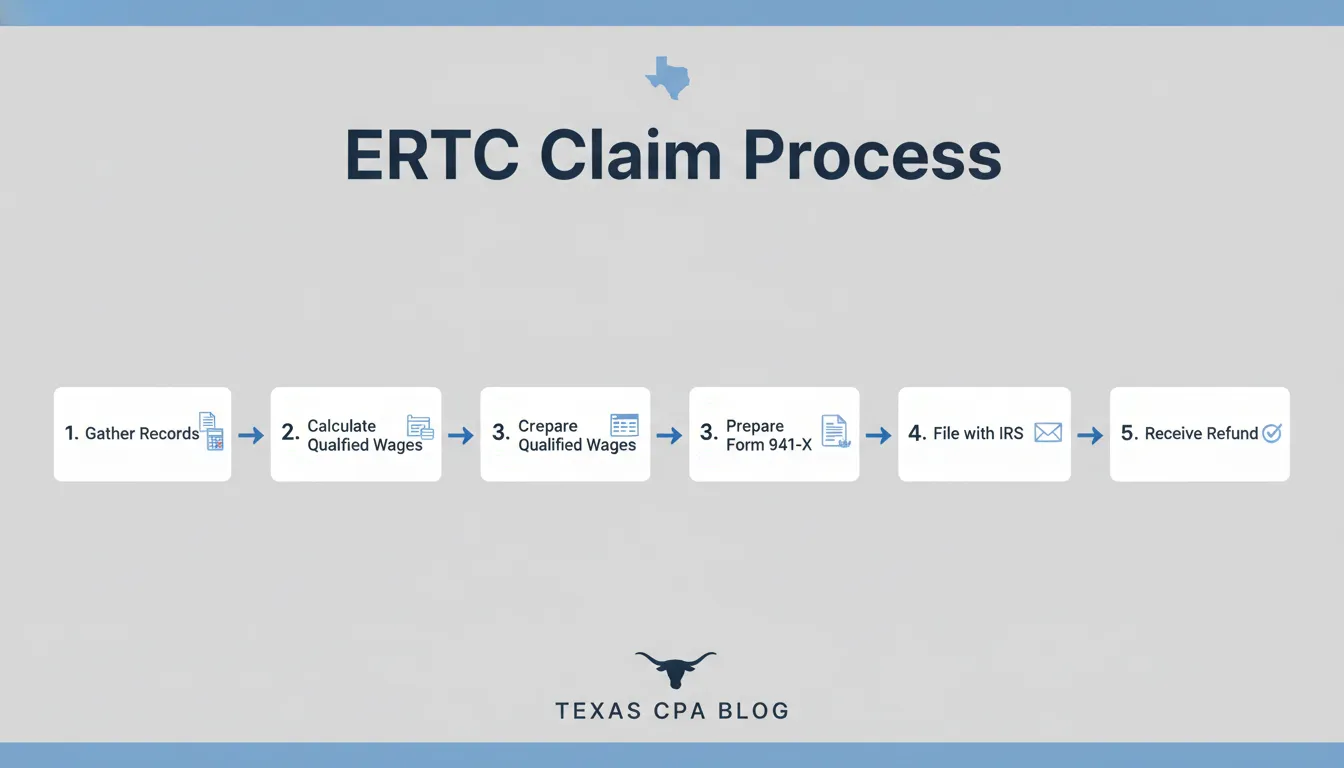
- Collect All Pay Records.
Gather your tax forms and pay lists. You need to show pay and health plan costs for each staff member for each quarter.
- Check Your Status.
Be sure you meet the sales drop test or the shutdown test for each period. This step ensures you only claim the credit when you truly qualify.
- Find the Credit Total.
Apply the right rates to your pay for 2020 and 2021. Each year has its own limits that you must follow to get the right sum.
- Prepare Form 941-X.
Work with a CPA to fill out the form to change your tax return. This form fixes your old filings so you can get the credit back.
- File and Track the Claim.
Send your forms to the IRS. Keep copies of everything and check on your refund. Be ready to give more facts if the tax office asks for them.
Working With a Dallas CPA
Filing on your own can be risky for a Texas firm. Using tax services in Dallas for Texas businesses helps you stay safe. A local pro can find red flags and make sure your math is sound. Cloud accounting services can also streamline your record-keeping and give you real-time access to the financial data needed for your claim.
Once your claim is filed, a CPA can track its progress and respond to any IRS inquiries on your behalf. This support is vital given the current six- to twelve-month processing times and heightened compliance scrutiny.
Frequently Asked Questions
Is the ERTC still available for Texas businesses in 2026?
Yes, you can still file for the credit by sending in an amended payroll tax return. Most Texas firms have three years from the date they filed their original return to make a claim. According to the IRS, the time to file for 2020 wages has passed, but many 2021 claims are still open. You should check your filing dates soon to ensure you do not miss the final cutoff for your business.
What is the current status of ERTC claim processing by the IRS?
The IRS is currently doing deep reviews of all new and existing claims to stop fraud. There was a long pause on processing new files, but the agency is now working through the backlog. According to the IRS eligibility checklist, they are focusing on high-risk claims first. This means it may take several months or more to get your check. You should ensure your records are ready for an audit just in case.
Can a supply chain issue qualify my Texas firm for the credit?
A supply chain problem by itself does not usually make you eligible for the credit. You must show that a specific government order caused the delay and that it had a big impact on your work. According to the IRS, you cannot qualify just because your costs went up or a vendor was slow. You need to prove that the government rules directly stopped you from getting the goods you need to run your business.
How long does it take to get an ERTC refund in Texas?
Most Texas businesses should expect to wait six months to a year for their refund check. The IRS has a very large backlog of forms to check, and they are moving slowly to prevent errors. Since the agency is doing closer reviews of each file, the wait times can vary for every firm. According to the IRS, you can track your status, but calling will not usually speed up the process for your tax refund.
Ready to see if your Texas business qualifies for the ERTC?
Failing to file your claim now could cause your firm to lose out on thousands of dollars in vital tax credits that you earned. The IRS keeps updating rules and handling times stay very long for any new files that your team sends to them this month. Starting your review today helps you secure your spot in line and gives you the best chance to get your funds as fast as possible. You can also learn more about our tax planning services to see how we help firms stay ready for any future audit.
Ready to see if your business qualifies for this credit? Call (972) 830-2622 to schedule a consultation with our team. We help Texas businesses navigate the ERTC filing process, ensure compliance with current IRS rules, and maximize every credit dollar you are entitled to claim.